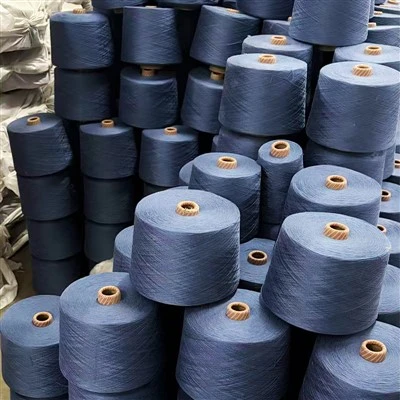
The solid acrylic yarn is mainly composed of polyacrylonitrile, which is made by copolymerization of more than 85 acetonitrile and no more than 15 di- and tri-monomers, and is made into staple fiber or filament by wet or dry spinning. The polyacrylonitrile content accounts for more than 85, which is called a monomer. The pure polyacrylonitrile has a compact structure, is brittle and hard, and has poor dyeability. The two monomers usually use compounds containing ester groups, such as methyl acrylate, methyl methacrylate, vinyl acetate, etc. After the two monomers are added, the regularity of the macromolecular arrangement becomes poor, and the intermolecular force is weakened, so that The fiber tends to be loose in the microstructure, the softness of the fiber is improved, the elasticity and hand feel are changed, and it is beneficial to the introduction of dye molecules to change the dyeability of the fiber. The content of the two monomers is about 5%-9%. In addition to affecting the dyeability of the fiber, its content also has a significant impact on other properties. When other conditions remain unchanged, as the content of the two monomers increases, the glass transition temperature of methyl acrylate decreases, and the fiber's heat-resistant discoloration stability decreases, that is, the fiber is easy to yellow after being heated, and the thermal creep of the fiber is increased. Increased, thermal shrinkage deformability is improved, initial modulus is reduced, and the fiber is easily deformed after being heated, but due to the increased flexibility of the macromolecular segment, the finished fiber exhibits better elastic recovery ability.
Bulk yarn is made by blending two kinds of fibers with different shrinkage rates into yarn. Then the yarn is treated in steam, hot air or boiling water. At this time, the fiber with high shrinkage rate will shrink and it is located in the middle of the yarn. However, the mixed low-shrinkage fiber is squeezed on the surface of the yarn to form a loop due to its small shrinkage, resulting in a bulky and elastic yarn. Bulk yarn is a yarn made by mixing high-shrinkage fibers and regular fibers in a certain ratio. The yarn is heat-moisturized and the high-shrinkage fibers shrink to form the core of the yarn. The regular fibers buckle to form the skin layer of the yarn, namely The so-called "skin core" structure, the use of bulky yarn to produce soft, fluffy, warmth-keeping textiles, is mainly used to make autumn and winter woolen sweaters. At present, some wool blended and chemical fiber wool-like bulked yarn products are sold in the international market. This type of product is a series of lightweight wool products woven from yarn spun by cotton spinning equipment, which is lighter, softer, warmer, and less lint than products made by spinning yarn on traditional wool spinning equipment.