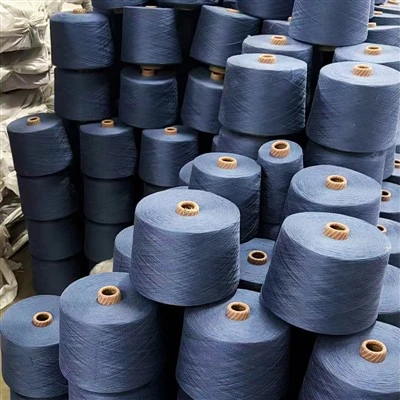
1. Historical evolution:
People have made polyacrylonitrile as early as more than 100 years ago, but because there is no suitable solvent, they have not been able to make fibers. In 1942, German Rhein and American Latham discovered that they had successfully obtained polyacrylonitrile fiber at almost the same time. In 1950, DuPont of the United States first carried out industrial production. Later, a variety of solvents were found to form a variety of production processes. In 1954, Fabien Bayer in the Federal Republic of Germany used the copolymer of methyl acrylate and acrylonitrile to make fibers, which improved fiber performance, improved practicability, and promoted the development of polyacrylonitrile fibers.
2. Basic features
The cross section of polyacrylonitrile fiber varies with the solvent and spinning method. The cross-section of wet-spun polyacrylonitrile fiber is basically round with tiny voids; dry-spun has a peanut shape with a denser structure. It is worth mentioning that dry-laid acrylic has higher bulkiness and coverage, soft and plump hand feel and good water permeability. Dry-laid acrylic of the same weight is more plump and thicker than wet-laid acrylic.
At present, there are not many factories producing dry-spun acrylic fiber raw materials. Only Qilu Petrochemical under Sinopec is retained in China, and DRALON is abroad (originally exported to China, but due to business problems, it is expected to be closed in 2021), India ACRYLICS (supplied more to the local market) and Peru DRYTEX (supplied more locally and South America) are limited in size and show a trend of shrinking
3. The advantages of ordinary acrylic fiber:
First, acrylic fiber is fluffy, soft, and looks like wool, so it has the reputation of "synthetic wool", so wool-type fabrics are often woven or spun into wool.
Second, due to the cavity structure and the introduction of the second and third monomers, the dyeing performance of the fiber is better, and the color of the fabric is bright;
Third, it has good thermoelasticity, which makes it possible to process bulked yarns;
Fourth, it has the best light fastness among common fibers. After 1000 hours of sunlight, the strength loss will not exceed 20%;
Fifth, acrylic fiber has good heat resistance, with a softening temperature of 190-230°C, second only to polyester in synthetic fibers, and is resistant to acids, oxidants and organic solvents.
4. Disadvantages of acrylic fiber
First, acrylic fiber is poor in alkali resistance, so be careful when using alkaline cleaners in the cleaning process;
Second, poor moisture absorption: Acrylic fabrics also have poor water absorption.
5. Basic classification of acrylic fiber
First, according to the color classification, it can be divided into matte, semi-gloss, bright and bright acrylic fiber;
Second, according to fiber shrinkage, it can be divided into high shrinkage acrylic fiber (30% shrinkage rate), shrinkage acrylic fiber (21%-25% shrinkage rate), and solid acrylic fiber (shrinkage rate <2%).
Third, it can be divided into ordinary acrylic fiber, triangular cross-section acrylic fiber, hollow acrylic fiber and flat acrylic fiber according to the different cross-sections.