Lace is roughly divided into six categories, namely: pure cotton knitted lace, crochet lace, warp knitted lace, embroidery lace, handmade crochet lace, etc. What are the characteristics of these six laces? The following is a detailed explanation for you all.
1. Pure cotton woven lace
Definition: Pure cotton woven lace refers to lace woven using a pure cotton disc knitting machine. The early pure cotton edges are mostly handmade products, such as shuttle lace, mallet lace, etc.
Features: The pure cotton edge pattern is clear and tidy, the pattern is easy to change, and there are not too many restrictions on the production batch, so it is widely used in clothing.
Pure cotton knitting machine: It is also called disc machine. At present, the main specifications have three models: 64 spindles, 96 spindles and 128 spindles. The working principle of the disc machine is to knit with nails. It uses pure cotton as the main raw material. Of course, this machine can also weave some laces of other fiber varieties.
In order to let everyone have a clearer understanding of pure cotton edge, we will briefly introduce two kinds of hand-woven lace.
01, shuttle lace
Definition: Shuttle lace, also known as lattice lace, is a kind of woven lace using shuttle as a tool. Popular in Europe in the 15th century, especially in Britain, France, and Germany.
Knitting process: first put the ball of thread into the shuttle cavity of the shuttle (a shuttle made of bovine bone or metal); then pull the thread from the small hole at the top of the shuttle, pinch the thread with the thumb and index finger of the left hand, and manipulate the shuttle with the right hand. Through the techniques of threading, looping, locking, etc., it can be knitted into various patterns of lace.
02, bobbin lace bobbin lace
Definition: mallet lace, also known as bobbin lace, is a kind of lace woven with cotton thread and twine by hand using wooden mallets as a winding tool. The mallet lace was originally a traditional European handmade lace, which was developed from the knitting process. The so-called pure cotton edge in China is a kind of mechanical lace developed on the basis of the mallet lace.
Weaving process:
① Place the lace drawing on the disc-shaped straw mat;
② Pierce metal pins on each part of the pattern to fix the position and direction of the knitting;
③ Wrap cotton thread around the upper end of a small mallet with a length of about 10cm and a diameter of about 10mm, pull the thread end, and fix it on a certain part of the drawing. Come);
④ Holding a small mallet in your hand, twist and entangle the cotton thread according to the shape of the pattern with a pin as a fulcrum, and knit into a lace. Different patterns need to use different weaving techniques. Artists use their fingers to manipulate numerous mallets to make them roll left and right, jump up and down, step by step, constantly changing positions, and weaving various patterns. Weaving techniques include plain weaving, interweaving, thin weaving, dense weaving and so on.
⑤ Pull out the pins and remove the lace from the straw mat. After ironing, it becomes a single piece of lace.
2. Crochet lace
Definition: We call lace produced by crochet machine as crochet lace.
Crochet machine: It is often used to knit narrow-width warp knitted fabrics such as lace bands, tassel bands, and elastic bands. (Tassel: A drooping tassel made of colorful feathers or silk threads, etc., often used in the skirts and hem of stage costumes.)
3. Warp knitted lace
Definition: Use 33.3-77.8dtex (30-70D) nylon yarn, polyester yarn, viscose rayon as raw materials, commonly known as warp knitted nylon lace. Warp knitted lace is knitted by warp knitting machine, which is an important category of knitted lace.
Knitting process: Use latch needles to make warp threads into loops, guide yarn bar to control flower warp knitting pattern, after shaping processing, open strips to form lace. The bottom weave generally adopts hexagonal mesh, which is woven individually. The grey fabric is divided into strips after bleaching and shaping, and the strip width is generally above 10mm. It can also be yarn-dyed into a variety of color bars and grids, without patterns on the lace. This kind of lace is characterized by its sparse texture, light and thin texture, transparent mesh, and soft color, but it is easy to deform when washed. It is mainly used as trim for clothing, hats, tablecloths, etc.
Raw material: The main raw material of warp knitted lace is nylon (nylon). If part of rayon is added to nylon, a multi-color lace effect can be achieved through dyeing (double dyeing).
Classification: According to whether the spandex elastic fiber is used or not, it is divided into: warp knitted elastic lace and warp knitted non-elastic lace.
4. Embroidery lace
Definition: Embroidery lace is a kind of embroidery, also known as "artwork". It is a decorative hollowed-out product that is embroidered or woven using cotton, hemp, silk or various fabrics as raw materials.
Classification: After a long period of development, there are more and more types of embroidery lace, including special embroidery lace, polyester-cotton continuous lace, tape embroidery, strip embroidery lace, water-soluble embroidery, printed embroidery lace, spray embroidery lace, hollow embroidery Lace, color embroidered lace, honeysuckle lace, segment dyed embroidered lace, tie-dye embroidered lace, applique embroidered lace, side strip embroidered lace, beaded embroidered lace and other types.
Knitting method: It can be divided into machine-embroidered lace and hand-embroidered lace. Machine-embroidered lace is a mass-produced lace variety developed on the basis of hand-embroidered lace. The machine embroidered lace has a wide variety of patterns, the embroidery is exquisite and beautiful, uniform and uniform, the image is vivid, full of artistic and three-dimensional feeling. At present, the production areas of machine embroidery in China are mainly concentrated in Shandong, Guangdong and Xiaoshao, Zhejiang.
Machine-embroidered lace: The machine-embroidered lace is embroidered by an automatic embroidery machine, that is, the striped pattern is obtained on the gray fabric under the control of the jacquard mechanism. There are two types of machine embroidery, small machine embroidery and large machine embroidery, and large machine embroidery is the most common. Machine embroidery has high production efficiency and low cost, and has been popularized by most manufacturers.
Machine embroidery materials: fabrics of various raw materials can be used as machine embroidery grey fabrics, but thin fabrics are mostly used, especially cotton and rayon fabrics have the best effect. The embroidery length is 13.7 meters (15 yards). Embroidering on a fabric of 13.5 meters long can be made into full-width embroidery or cut into lace strips. According to different requirements, different embroidery base fabrics can be used to produce different types of lace, such as water-soluble lace, mesh lace, pure cotton edge, polyester cotton edge and various tulle sliver laces, etc. The pattern can be adjusted at will .
Machine embroidery knitting process: 2bw.Megx machine embroidered water-soluble lace is a large category of embroidery lace. It uses water-soluble non-woven fabric as the base fabric and viscose filament as the embroidery thread, which is rusted on the base fabric by the computer embroidery machine , And then hot water treatment to melt the water-soluble non-woven base fabric, leaving a three-dimensional lace. It can be made into strips and special-shaped flower patterns according to the requirements of use. The latter is widely used in the decoration of clothing collars and bras. The embroidery machine is equipped with a multi-color automatic color selection and color-changing device, which can be used for single-color machine embroidery or multi-color machine embroidery. Generally, the longest flower back can be up to 650 mm, and the lace width is more than 10 mm.
5. Handmade crochet lace
Definition: A type of drawnwork, which uses cotton thread as the main raw material and is hand-knitted with crochet lace. Also known as Gouhua. The crochet hook is made of metal, bamboo, wood, bone and other materials, with a hook on the top.
Features: The knitting tools are simple, the knitting technique is changeable, and it has a hollow and three-dimensional artistic effect.
Knitting process: the knitters knit the thread with the left hand and crochet with the right hand, and knit into a fancy pattern by winding and crocheting. According to different stitches and procedures, different fancy styles are produced, mainly including the morning stool, a pillar of incense, elephant eye block, lotus petals, plum blossom network, chain buckle, sweet-scented osmanthus nets, etc., and then the different fancy styles are connected into various patterns.
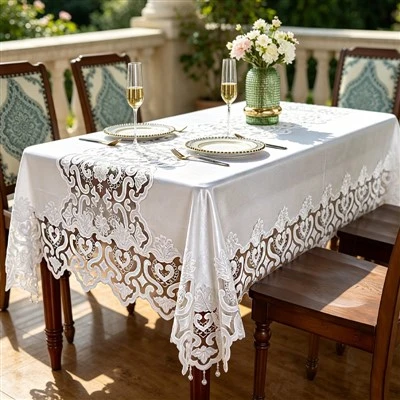
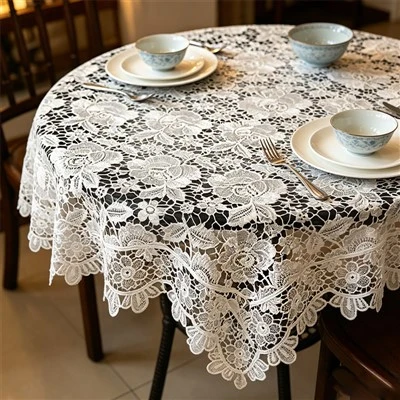
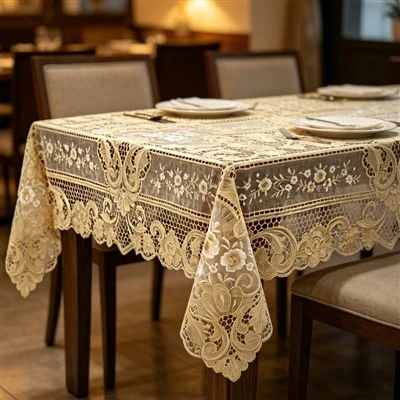
Application: There are many types of products, the common ones are small flowers, lace strips, collars and other clothing accessories used for clothing decoration; tablecloths, beddings, cushions, etc. used for interior decoration; in addition, there are crochet clothing, crochet clothing and three-dimensional animal and plant hooks Products and so on.
6. Other lace
With the increasing development of personalization of clothing products, there are many types of lace as an important component of clothing design. Here we briefly list some varieties:
Hand-operated flowers: on the basis of taping embroidery, assisted by hand-knitting;
Ultrasonic lace: use the principle of ultrasonic heat melting to perform edge trimming, trimming, cracking, hot stamping, welding, slitting, forming, threading and other heat treatment methods, cutting out various flower-shaped holes with wisps, and performing edge melting treatment ;
Color sequin lace: lace or lace belt made of various laces or belts combined with hand embroidery technology;
Weft-knitted lace: As a new category of knitted lace, weft-knitted lace began to appear and have been used to a certain extent. Weft-knitted laces are mostly made by computerized horizontal machines.
There are many kinds of lace, and the six categories mentioned in this article are relatively common. With the changes in fashion trends, lace styles, materials, craftsmanship, etc. are constantly evolving and updating, and new laces are always being born.